Archive for February, 2010

Modern Library Metadata

By George Oates

The Open Library team is lucky to work with Karen Coyle, our resident metadata czar.

Karen recently completed an article called Understanding the Semantic Web: bibliographic data and metadata. The full article is issued in Library Technology Reports, v. 46, Issue 1, January 2010, which you can purchase, but there’s also a PDF chapter online:

Library Data in a Modern Context (PDF, ~500KB)
This chapter of “Understanding the Semantic Web: Bibliographic Data and Metadata” explores the history of library data and where it stands in a modern context. The rise of a new information environment—the World Wide Web—has revealed the downside of the long history that libraries have with metadata. The question that we must face, and that we must face sooner rather than later, is how we can best transform our data so that it can become part of the dominant information environment that is the Web.

We’re hoping that Open Library will be an instantiation of the ideas that Karen describes in her article, particularly around topic search and the idea of creating a web of data around books.

Internet Archive Salon in San Francisco

By George Oates

When: Wednesday, March 3, 2010, 7:00pm – 10:00pm
Where: Gray Area Foundation for the Arts @ 55 Taylor Street, San Francisco, CA 94102 (Map)

The Internet Archive is holding a salon to discuss the resources available at the Internet Archive, how artists and creative people can access and contribute to the Archive, or to our Open Library and BookServer projects. The salon will be hosted by Gray Area Foundation For The Arts (GAFFTA), here in San Francisco.

The Internet Archive is building an Internet library offering permanent access to historical collections that exist in digital format. The Archive holds more than 100,000 hours of television, 200,000 moving images, 400,000 audio recordings, 1,800,000 books and 150,000,000,000 web pages (through the Wayback Machine).

In addition to providing access to these materials the Archive can be a resource for storage and bandwidth for appropriate publicly-accessible projects (for example the Electric Sheep distributed computing artwork and Creative Commons licensed feature film Sita Sings The Blues). The Open Library aims to have comprehensive information about every book ever published. It is wiki-editable and provides a data API that can be used to retrieve information about books and authors. The BookServer initiative aims to create an open ecosystem for vending and lending digital books.

We hope that you will join us in our mission of Universal Access To All Knowledge. Perhaps your project can help others access the resources of the Internet Archive and even help build it.

Please RSVP to salon@archive.org if you’d like to come. Space is limited.

The Enemies of Books

By George Oates

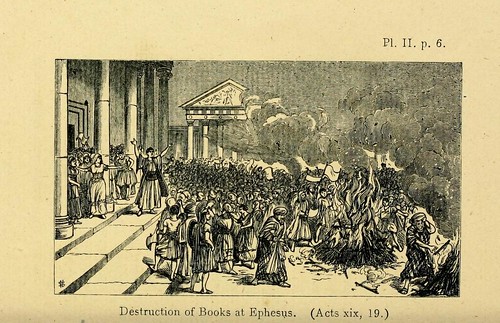
Destruction of Books at Ephesus

I learned a new word today: biblioclast, or destroyer of books. Found it on the frontispiece of The Enemies of Books by William Blades.

As you can see from its Table of Contents — Fire, Water, Gas and Heat, Dust and Neglect, Ignorance, The Bookworm, Other Vermin, Bookbinders, Collectors & Servants and Children — the author, William Blades, has spotted elemental, entomological and occupational enemies, even as far back as 1880.

John Bagford, “shoemaker and biblioclast,” appears in the chapter about Collectors. He apparently “went about the country, from library to library, tearing away title pages from rare books of all sizes,” intent on creating a key to the history of printing, but detaching key bibliographic information from parent works. You can see glimpses of The Bagford Fragments on the British Library’s website.

It was the conclusion, “A Reverence for Old Books,” that got me though:

It is a great pity that there should be so many distinct enemies at work for the destruction of literature, and that they should so often be allowed to work out their sad end. Looked at rightly, the possession of any old book is a sacred trust, which a conscientious owner or guardian would as soon think of ignoring as a parent would of neglecting his child. An old book, whatever its subjects or merits, is truly a portion of [inter]national history; we may imitate it and print it in facsimile, but we can never exactly reproduce it; and as an historical document it should be carefully preserved.

I do not envy any man that absence of sentiment which makes some people careless of the memorials of their ancestors, and whose blood can be warmed up only by talking of horses or the price of hops. To them solitude means ennui and anybody’s company is preferable to their own. What an immense amount of calm enjoyment and mental renovation do such men miss. Even a millionaire will add a hundred per cent to his daily pleasures if he becomes a bibliophile; while the man of business with a taste for books, who through the day has struggled in the battle of life with all its irritating rebuffs and anxieties, what a blessed season of pleasurable repose opens upon him as he enters his sanctum, where every article wafts to him a welcome, and every book is a personal friend.

It seems with every day I gently uncover voices of bibliophilic history. I’m curious about what a new edition of this book might contain today.

New coat of paint

By George Oates

Just a note to say that we’ve just updated the design of the Open Library blog. Thanks to Lance & Raj!

In lieu of the soft launch, we thought it might be nice to give you a teeny taste of the new look.

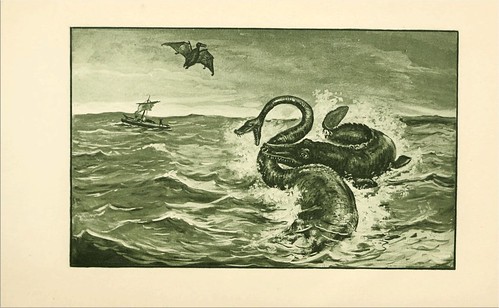
Life in the Primordial Sea

Joyeux anniversaire, Monsieur Verne!

By George Oates

Happy Birthday, Jules Verne!

“The expander of horizons,” is what a noted critic called Jules Verne. He was the prophet, the foreseer and foreteller of our great mechanical age.”1

Jules VerneJules Verne, one of the “fathers of science fiction,” was born today, back in 1828. He wrote several hundred tales about travels to exotic locales in incredible machines. Science fiction’s other father is Englishman H. G. Wells, born about 40 years later. Apparently, Verne is also one of the most translated author in history, second only to Agatha Christie in his global reach2.

The opening paragraphs of one of his most famous stories, 20,000 Leagues Under the Seas, will give you a hint:

The year 1866 was signalized by a remarkable incident, a mysterious and inexplicable phenomenon, which doubtless no one has yet forgotten. Not to mention rumors which agitated the maritime population, and excited the public mind, even in the interior of continents, seafaring men were particularly excited. Merchants, commons sailors, captains of vessels, skippers, both of Europe and America, naval officers of all countries, and the governments of several states on the two continents, were deeply interested in the matter.

For some time past, vessels had been met by “an enormous thing,” a long object, spindle-shaped, occasionally phosphorescent, and infinitely larger and more rapid and its movements than a whale. Read on?

After poking around the library a little, I found the 1900 Hetzel edition of Voyage au Centre de la Terre full of gorgeous illustrations. I also uncovered a few scanned volumes of the complete Works of Jules Verne, in particular Volume 1, Volume 2 and Volume 4. (There may be more available online… In the 1911 edition, I see that 15 volumes were published originally, in 600 numbered copies.)

Update: Feb 19, 2010 – Spotted these gorgeous cover designs by Jim Tierney over on Vimeo:

Jules Verne cover designs by Jim Tierney from Jim Tierney on Vimeo.

]]>

Jules Verne cover designs by Jim Tierney from Jim Tierney on Vimeo.