Monthly Archives: December 2025

Celebrating Our Community in 2025

Highlights From the 2025 Open Library Community Celebration

This year, staff, fellows, and volunteers made a number of improvements to Open Library. Here are some highlights of contributors’ accomplishments in 2025, as presented in the annual Community Celebration.

  • Ray Berger, volunteer Developer Experience Lead celebrated his fifth year with Open Library, having reviewed and merged more than 100 pull requests in 2025. This year Ray launched https://docs.openlibrary.org, a new searchable portal for developer documentation. To improve website performance, Ray upgraded the Open Library Search APIs to use FastAPI, a more performant, modern web framework. He has also helped modernize the code base to make it easier for developers to contribute. 
  • GSoC Engineering Fellow Sandy Chu worked with staff members Drini Cami and Mek to enable on-the-fly translations in BookReader. Now, books in BookReader can be translated into more than 40 languages. This project also enabled read-aloud capabilities in BookReader, which helps to close the accessibility gap for international readers. 
  • Engineering volunteers David Ragipi and Krishna Gowsami redesigned book lists to add a “follow” button next to usernames. The feature increased the number of patrons following each other from 182 to more than 3K followers in 2025.
  • Under Mek’s mentorship, GSoc Engineering Fellow Roni Bhakta developed a prototype of Lenny, a self-hostable digital library for storing and lending EPUBs. Lenny gives libraries and individuals a lightweight way to host and securely lend the EPUBs they own.
  • Engineering Fellow Ben Deitch worked with Drini to develop a new trending algorithm built on Solr that uses hour-by-hour statistics to give patrons fresh, timely books that are getting high interest at any given moment on Open Library. This feature replaced trending views that changed infrequently and also gives insight into what’s trending in a given subject.
  • Engineering Fellow Stef Kischak worked with Drini to develop a script that scrapes Wikimedia APIs for Wikisource ebooks to import. Stef also made efforts to improve the import pipeline and identify orphaned editions to edit.
  • Librarian Fellow Jordan Frederick imported reading levels metadata that improved the K-12 reading collection. Jordan also fixed metadata, split wrongly merged records, and created tutorials for Open Library patrons. 
  • New librarian volunteer Catherine Gosztonyi created the still-growing Canada Reads Awards collection on Open Library. 
  • Internet Archive Staff Member Lisa Seaberg celebrated the 684 volunteer librarians in the Open Library community Slack channel. Volunteer librarians improve the catalog by adding metadata, author info, images, and collections. Lisa also recognized multiple superlibrarians who reviewed hundreds of thousands of merge requests, curated special collections, and mentored librarians in training.
  • Volunteer communications lead Elizabeth Mays, with team Nick Norman, Ella Cuskelly, and Jordan Frederick, doubled the number of blog posts published in 2025 and streamlined a process for writing and approving blog posts. The group also defined standard starter tasks for future volunteers toward projects that will enable more frequent social content. 
  • Staff member Drini Cami highlighted the work of the developer community on a unified read button, language-aware autocomplete and carousels, full-text list search, new librarian features, Wikipedia links on author pages, and Wikidata integration. Drini presented staff improvements such as a data-quality tool that lets librarians see which popular books are missing metadata, streamlined special access for patrons with qualifying print disabilities, grid view, and security improvements to prevent cyberattacks. 

Watch the replay of our 2025 Community Celebration or these slides to learn more about these upgrades. 

Previous Community Celebrations

This is Open Library’s sixth Community Celebration to recognize contributors, who come from more than 20 countries. Catch up on past years’ events at these links:

2024, 2023, 2022, 2021, 2020

Get Involved

If you’d like to get involved, indicate your interest in volunteering with Open Library in this interest form. We’ll be in touch to connect you to the community Slack and weekly call. 

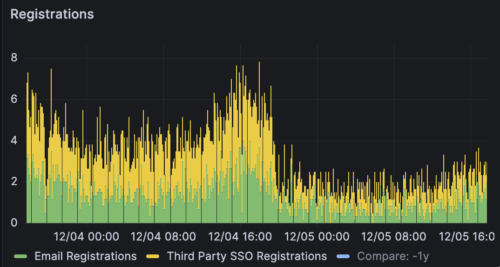
The result of implementing a change which lowered the quantity but increased the quality of sign-ups.

Achieving More with Less

Setbacks: 2025 has been a challenging year for the Open Library community and the library world. We began the year by upgrading our systems in response to cybersecurity incidents and fortifying our web services to withstand relentless DDOS (distributed denial of service) attacks from bots. We developed revised plans to achieve More with Less to meet the needs of patrons who lost access to 500,000 books due to late-2024 takedowns. The year continued to bring setbacks, including a Brussels Court order, which resulted in additional removals, and contesting thousands of spammy automated takedown requests from an AI company. Just last month, we responded to a power outage affecting one of our data centers and then a cut that was identified in one of our internet service provider’s fiberoptic cables, resulting in reduced access.

Given all these setbacks, why weren’t we seeing a decline in sign-ups?

Less is More: Putting patrons’ experience first. As the year progressed and we reviewed our quarterly numbers, one metric that circumstantially held high was sign-ups. The Open Library is historically a significant source of registrations for the Internet Archive, contributing to approximately 30% of all registrations. Some websites may have found it reassuring that, despite all the challenges presented in 2024 and 2025, adoption seemed to keep its pace. At the Open Library, we measure success in value delivered to readers — not registrations — and this trend seemed to indicated something may have become out of balance:

What reason(s) might explain why registrations remain steady when significant sources of value are no longer accessible?

We hypothesized some class of patrons are signing up with an expectation and then not getting the value they are expecting.

Testing the hypothesis: The first step of our investigation was to take inventory of the possible reasons one might register an account. Each of the following actions require accounts:

  • Borrowing a book
  • Using the Reading Log
  • Adding books to Lists
  • Community review tags
  • Following other readers
  • Reading Goals

Supporting Evidence: We started by reviewing the Reading Log because it’s the platform’s largest source of engagement, with 5M unique patrons logging 11.5M books. We discovered that millions of patrons had only logged a single book. There’s nothing inherently bad about this statistic, in fact many websites may be happy about this engagement. However, unlike many book catalog websites, the Open Library is unique in that it links to millions of books that may be accessed through trusted book providers. It is thus reasonable that many patrons come to the Open Library website with the intent of accessing a specific title. This data amplified occasional reports from patrons who expressed disappointed when clicking “Want to Read” did not result in access to the book.

Refined hypothesis: Based on these learnings, we felt confident the “Want to Read” button may be confusing new patrons who thought clicking the button would get them access to the book. Under this lens, each of these registrations represents adoption for the wrong reason: i.e. a patron is compelled by the offering to register, but they bounce because what they get is a broken promise.

Trying a solution: Data gave us confidence the “Want to Read” button may be confusing new visitors to the site, but it also revealed that hundreds of thousands of patrons are actively using the Reading Log to keep track of books and we didn’t want to confuse the experience for them. We decided to change the website so that non-logged-in patrons, would see the “Want to Read” button as “Add to List” instead, whereas logged-in returning visitors would continue to see the “Want to Read” button they were used to.

The original button presented to patrons, which shows a potentially misleading: "Want to Read"
Before: The original button presented to patrons, which shows a potentially misleading: “Want to Read”
The button presented to logged out patrons after the change, reading "Add to List" instead of "Want to Read"
After: The button presented to logged out patrons after the change, reading “Add to List” instead of “Want to Read”

Results: When our team launched this week’s deploy, we noticed a few performance hiccups: our latest deploy increased memory demands and our servers began using too much memory, causing swapping. After some fire-fighting, we were able to make adjustments to our workers that normalized performance, though we remained alert.

A chart from Open Library's grafana system indicating that the website was facing a large number of 503's (i.e. it failed to respond to patron requests)

Later that night, we noticed a significant drop in registrations and started frantically testing the website:

A chart from Open Library's grafana system indicating that registrations-per-minute had fallen in the latest deploy.

We were thrilled to realize that our services are working correctly and the chart accurately reflected — what we hope to be — a decrease in bad experiences for our patrons.

Conclusion: Sometimes, less is more. We anticipate this will be the first small change in a long series of marginal improvements we hope to bring us closer into alignment with the core needs of our patrons. As we move towards 2026, we will continue to respond to the new normal shaped by recent events with the mantra: back to basics.